Showing posts with label pun achieved. Show all posts

Tuesday, 18 August 2015

Blaugust 18/31: The Good Samaritan is a Bad Economist

This post is the 18th part of the Leaflocker's second-annual attempt to complete Blaugust East, and the fifth-annual attempt to complete Blaugust Prime. It's all going very well so far.
 
A reminder that last week's quiz will be marked in the next 24 hours. The only way to lose is not to play.
 
If you're not a regular visitor to these fair climes, you might not know that by local custom, each Tuesday features the weekly round-up of the Leaflocker Reading club, which is currently 7 weeks into a 350 week project to read The Great Books of the Western World at a gentle, sleepy pace agreeable to the gentlemanly scholastic after a hearty luncheon. That means we're about 2% of the way through already! We'd love you to join us by picking up some or all of the readings for this week and dropping by next week for discussion on them.

Due to a short turnaround after the delays of last week, I once again struggled to get all the reading that needed to be done complete in time. But never fear, we have a plan to hit the emotionally intense Lolita earlier in the week, then move into the heavier philosophical and scientific works, and dip into the lighter fiction if and when I need a break. This seems to have the advantage of leaving me Dickens to catch up on Tuesday nights, which is proving a light way to finish up the week and put me in the right mental state to prepare for another week. 

What method are you using to tackle the task that is before us, fellow reader?
 

Week 7 in Review


Last week: 119
Conversation so far: 748
 
Lolita by Vladimir Nabokov
Part One, Ch. 28 - 33
 
We conclude Act I of Lolita in a big rush, very much the big rush, with all of the pieces falling into place for the Great American Road-trip novel that Michael assures me is what is awaiting us in the second half of the piece. Nabokov continues with his mastery of discomforting the reader, leaving much unsaid, darting back and forth from a distant position as narrator to right up close through his frustratingly inconsistent chapters. I'm thankful for the unreliable narrator here, and if such a concept was developed through books like this one then I think I appreciate the power of it as a literary device, to discombobulate the reader, all the more.

I can't say at this point that I'm likely to become a regular reader of this one.

 
Hard Times by Charles Dickens
Book the Second, Ch. 10 - 12
 
Well, Blackpool as at least escaped the spotlight, for now. Instead, we focus on the trials of poor Louisa and the man that she might or might no be in love with, having been so thoroughly Gradground as to not be able to tell the difference. The joy of these chapters was in watching Mrs. Sparsit (I cannot yet decide if she's a hero or a villain) rush about like a mad hen and be so successful about it, too.


Odyssey of Homer
Books I-IV
 
There are more than a hundred published English translations of the Odyssey. The distinguishing feature of the Rieu translation that I'm reading (apart from the Rieufully dis-respectful cover art) from that of the earlier Butler translation that I've been linking to is that the physical copy uses the Greek names for things whereas Butler and most of the classical translations use the Roman ones. As someone who grew up with the Greek, this feels much more comfortable to me. I'm in no position to judge the accuracy or quality of translation, this being my first reading of the Odyssey in about a decade and me not reading ancient Greek and all, but the Rieu translation seems to be the less poetic, more literal of the two. Since I'm reading this for the story, not the translators art, I think I prefer that. If you're a fan of another translation, do let me know.
 
We're not really into the meat of the story so far, so all I can really say on that point is that I hope that Odysseus fellow makes it home some time soon, as it seems like something is rotten in the state of Ithaca. I'd forgotten that Athene played such a 'physical' part in this story, taking on the guise a various persons and interacting with the characters directly person-to-person. It's nice to be reminded that the Greeks believed in this kind of interaction with their deities, rather than just the kind that requires turning into swans, etc. that you usually hear about.
 
 
Gettysburg Address by Abraham Lincoln
 
But, in a larger sense, we can not dedicate, we can not consecrate, we can not hallow this ground. The brave men, living and dead, who struggled here, have consecrated it, far above our poor power to add or detract. The world will little note, nor long remember what we say here, but it can never forget what they did here. It is for us the living, rather, to be dedicated here to the unfinished work which they who fought here have thus far so nobly advanced. It is rather for us to be here dedicated to the great task remaining before us—that from these honored dead we take increased devotion to that cause for which they gave the last full measure of devotion—that we here highly resolve that these dead shall not have died in vain—that this nation, under God, shall have a new birth of freedom—and that government of the people, by the people, for the people, shall not perish from the earth.
 
What a powerful orator Lincoln must have been. These words are pretty darn timeless, aren't they? I can imagine that this paragraph could easily be used in our Remembrance Day or ANZAC day services, had they not the religious connection and the obvious association with the US once you get to the "for the people, by the people" bit.
 
 
The Eruption of Vesuvius (Letters LXV and LXX) of Pliny the Younger
 
So far the Roman historians seem far too interested in pushing their own political agendas for them to be taken too seriously in a modern context. As it's going, Pliny might be an excellent candidate to run an Royal Commission.
 
How a chronic asthmatic got to be a naval commander is a little beyond me, but if I were that naval commander I don't think I'd go rushing into the noxious clouds of a volcano, obstensibily to rescue friends, since it's apparent that those same friends got out fine without Pliny's intervention. Maybe it's forgivable since its obvious that the Romans at this point had no idea what a volcano was, but still, there's a fine line between bravery and stupidity here. If nothing else, there's the beautiful image of roman nobles rushing about with pillows stuck to their heads to try to avoid falling pumice, that's got to be good for a laugh or two.
 
 
On Old Age by Marcus Tullius Cicero
 
Through the medium of Librevox, I tried to ear-read this one on the journeys to and from work this week, with varying levels of success. The philosophy was enjoyable, but the technology was letting me down a little. I might have a to try a more sophisticated solution to my time-budgeting if I'm going to make ear-reading work for me. I'm also not totally convinced that driving is the ideal situation in which to contemplate philosophy.
 
There's also a section in his conclusion in which Cicero refers to that puzzling section of Plato's Meno that we covered last year, suggesting that the soul is immortal and that it 'remembers' things rather than having to be taught them. I find it fascinating that so many philosophers got hung up on this point. Cicero has some things to say on the immortal and indivisible soul in these closing passages, but I'm convinced that others will argue the point better, if less concisely, over our Conversation, so I'll let him go for now...
 
Anyway, yes, this is a lot sexier than "On Friendship". In "On Old Age", we've given Cicero the time to set out a long-term argument, that we can better see the power of persuasion for which he is so renowned. As to whether the content of the letter is true, that a fulfilled old age is better than one's youth, I suppose that I'll have to keep using this little brain of mine and return in a few decades to see if it holds true. Is this a great book? Honestly, yes, I think it is, for Cicero's method of argument more than his points. I begin to wonder that this whole attempt of labelling some of these books as great and some as not is a vanity that is becoming increasingly preposterous, but I guess it's too late to stop now...
 

Week 7 Readings


Since we're leaving the GGB stuff allocated to us by by Dr. J at the door this week, we have a pretty light week of mandatory readings before we start ramping it up over the next fortnight or so. We're going to take the opportunity to really make some solid progress with our ongoing trio of novels. I hope you're all strapped in for the return of Hugo and some good progress with our now familiar friends, Dickens and Nabokov.
 

Lolita by Vladimir Nabokov
#not_gbww #copyrighted #fiction #english
Part Two, Ch. 1 - 2 (24 pages)

I'm all psyched for the second book and whatever good stuff is coming my way as Humbert and Charlotte tour the Usonian countryside. Don't let me down Victor/Michael.
 
 
Hard Times by Charles Dickens
#not_gbww #fiction #english
Book the Third, Ch. 1 - 5 (40 pages)

I'm all psyched for the third book in which all the baddies get what's coming to them, if the narrative tradition and Mr. Dicken's moralising can be trusted. I mean, there's no point detailing the criminality of the upper classes and then letting them get away with it, is there?
 

Les Miserables by Victor Hugo
#not_gbww #fiction #french
Book Four (10 pages)
 
I think it should be a nice change to get back to Hugo after another week off. Every time I come back I am attracted once again to his gentle, infinitely distractable style all over again. Unless I'm very much mistaken, this book should detail how Fantine came to leave her daughter behind her.
 
The Odyssey of Homer
#gbww #fiction #greek
Books V-VIII (34 pages)
 
There's the off chance that the story will finally catch up to Ulysses/Odysseus and there's a good chance that we might even find out what he's been up to these long years. Mrs. Owl doesn't think that Greek Epics are appropriate out-loud bedtime reading, for some reason.

 
To the Reader by Michel de Montaigne
#new #oneshot #essay #gbww #french #reallyshort
(1 page)
 
One page? One page? This looks like a preface... Presumably this is the lead-in to something else later in the GBWW. I hear Montaigne pretty much invented the literary essay, so I guess we'll have to see how that goes.


Good luck with all your endeavours, literary and otherwise, this week. And try to keep warm!

Wednesday, 12 August 2015

Blaugust 12/31: A pain somewhere in the room

This post is part of Blaugust East. That festival of gaming blogging only very tangentially related to Great Books. It's also part of what I've taken to calling Blaugust Prime inside my own head, but that doesn't have a fancy page to link to.

For those of you that are interested, yesterday's post has been updated with the results of last week's quiz.

When I was a child, and throughout high school, I was a voracious reader. I would devour books, and between fortnightly visits to my local library I would regularly read a few-thousand pages on anything and everything that I could get my hands on. Lately, I've found it pretty difficult just to find the time to read a hundred pages or so each week, in between making a token effort in packing a house, finishing up my work commitments, and trying to be an active member of the blaugust community too. Oh, and seeing my wife some time...yeah, there's always something you forget, isn't there?

Never mind me. I hope that you found a little peaceful time this week to read, and think about what you've been reading, whether you're following along with this little project of ours or reading something else. It's nearly always time well spent, and I found the time that I did manage to scrape together this week was very rewarding.


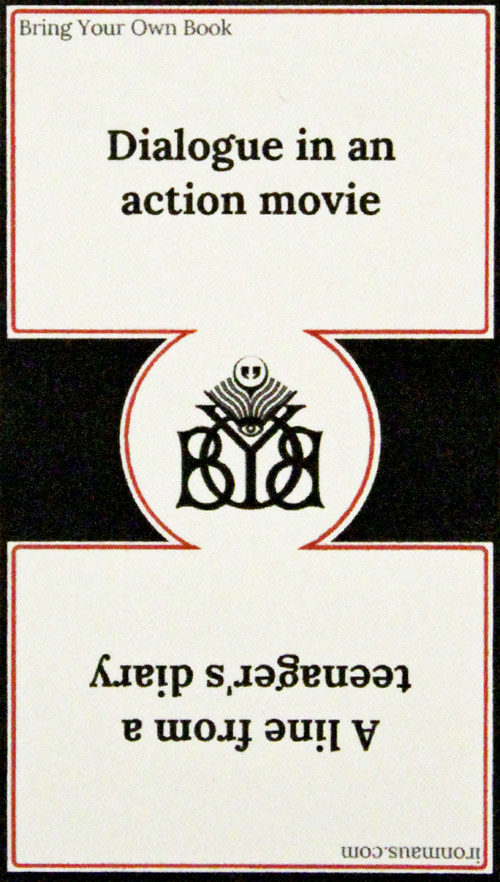
To celebrate the release of "Bring Your Own Book", a Balderdashy/Apples to Applesey card game that I checked out earlier in the year that is essentially a more sophisticated version of the SF classic "Clench Racing" (which I've always wanted to run as a convention event, but I run the wrong type of conventions). I played the preview version of BYOB while reading this week and have posted my efforts. I'll let you decide how I did.

Week 6 in Review

Last week: 102 pages
So far: 629 pages
Hard Times by Charles Dickens
Book the Second, Ch. 7 - 9

Title of a mystery novel: "When the Devil goeth about"

A more story-driven excerpt from Dickens after the heavy-handed preaching that we've been having the last few weeks. Aha! That's what Tom was up to, the little sneak! Harthouse's scheme's haven't come to their conclusion, yet, but I have a sense that they're coming. The star of these chapters is the final appearance of everyone's favourite worrier, Mrs. Gradgrind, who provides both our title quote for this week and this reminder of week one of our little project: ‘You learnt a great deal, Louisa, and so did your brother. Ologies of all kinds from morning to night. If there is any Ology left, of any description, that has not been worn to rags in this house, all I can say is, I hope I shall never hear its name.’


Les Miserables by Victor Hugo
Volume i, Book Three

Lyrics from a Country & Western Song: "I regret the time when I saw Bonaparte and Talma enter the Bel Savage arm in arm." (I could ha' struck him down right then and there, but I done left my gun down on the farm)

Aside from the first chapter, one of Hugo's delightfully whimsical jaunts down memory lane in French history, it seems that this book exists just to establish that Fantine was very in love, and ultimately a good girl, and that's she wasn't acting in a sinful debaucherous sort of way when she was made pregnant by a man who will never again be seen in the story. I guess this would have been important to Hugo's readers, but it's in stark contrast to a modern story where the additional element of a 'fallen woman making good' would be a more attractive prospect than setting Fantine up as some kind of virtuous saint.


Mowgli's Brothers, excerpt from The Jungle Book by Rudyard Kipling

Item for a Curriculum Vitae: "I speak for the man's cub."

Readers only familiar with the Jungle Book from the Disney film might find this one a little strange, and I appreciate a scatting monkey and a bear making a hulla-Baloo as much as the next man, but this is the version of the Jungle Book that I'm most familiar with, since my grandparents brung me up right. Kipling has a wonderful sense of the defining characteristics of different animals, but while I found this a pleasant diversion from some of the week's other reading and will one day look forward to reading it with my own children, I don't think this one is "Great".


Apology by Plato

A universal truth: "...either death is a state of nothingness and utter unconsciousness, or, as men say, there is a change and migration of the soul from this world to another." (is it cheating to use a philosophy text for this one?)

My new tracking page proudly proclaims that Plato is now my most-read author in terms of number of titles, but since that number is two, I guess that's not that exciting. What is exciting, is that the Apology kicks Meno's ass.

The classic example of how philosophers are too damn clever by half. Socrates makes a reasoned argument, cross-examines his accuser with literally the textbook use of his Socratic Method to demolish the prosecution's points (well, some of his claims are a bit meh, but...), and pretty much gets himself off. Having accomplished this, in his moment of triumph, he proceeds to remind everyone why they hate him, get each and every one of their backs up, and then act smug when they hand down the guilty verdict that he all but goaded them into giving. Having not learned his lesson, he then goads them with fine logical arguments into handing down the death penalty, before launching into his hauntingly beautiful philosophical swansong in the form of a discussion on the nature of death. Maybe my opinion is coloured by my last reading having occurred on a beautiful beach during an Australian summer, but I cannot imagine a finer way for a philosopher to go out. This one is definitely going straight to the pool room.


Taming of the Shrew by William Shakespeare

A pick up line: "I'll pheeze you, in faith." (I don't know what that is, but it sounds pretty dirty).

Of Shakespeare's comedies that I've read, which admittedly is not a large number, this one makes the most sense. Easily readable and laugh out loud funny in parts, this was a breeze to read, but those of modern sensibilities will find the overarching message (that of women being the possessions and playthings of men, and how a wife should worship the very ground her husband walks on) somewhat disturbing. That this message is pounded home in the closing scene by Katharina herself, the spirited woman tricked out of her own self by a scheming husband, is just salt in the wound.

I still think this one belongs in the list of truly great books, despite its message being a foreign one to my own modern ears. Almost all the loose ends are tied up (the exception being the disappearance of the play-within-a-play motif following the second act), and the whole thing flows together. Very tight, very enjoyable. I'd still recommend it.


Lolita by Vladimir Nabokov
Part One, Ch. 28 - 33
In my desperation to get my readings finished this week, I took Lolita to a meeting in case I had any spare time, and accidentally left her behind. The poor girl must be feeling a little neglected. Anyway, I was keen to get back into Nabokov this week after being admonished by Michael, but it wasn't to be due to my own generally clutzy forgetfulness. Once I get her back, I'll push this reading to next week.

Week 7 Readings

Here comes the big one, baby! The Odyssey! Also available on Dr. J's smorgasboard this week is a bunch of other good stuff, so we'll dip heavily into that and leave off Les Mis. once again to make room. We're leaving Bacon behind as I've realised that his Essay's are on the supplementary list that we'll be reading, so there's no need to cherry pick individuals ones right now. A couple of short readings this week too that should be worth your while, if any of you are tempted to dip in but don't want to commit too much time.

Lolita by Vladimir Nabokov
#not_gbww #copyrighted #fiction #english
Part One, Ch. 28 - 33 (22 pages)
A week for the tension to build is quite enough, I think. Here's hoping that we manage to retrieve the poor lass from where I've left her and really dig into Nabokov this week. 

Hard Times by Charles Dickens
#gbww #fiction #english
Book the Second, Ch. 10 - 12 (? pages)
Time to finish up act two of three. That means that nothing it going to get any better for our heroes in the next three chapters. Predictions: Cissy appears not at all, Louisa does something silly, and poor old Stephen Blackpool gets thrown in prison with Loo's few donated pound as supposed proof of his guilt.


Odyssey of Homer
#new #gbww #philosophy #greek
Books I-IV, (43 pages)
I grew up on the Greek myths and legends, so Homer has always been a little special to me; but it's been a few years since my last reading of the Odyssey, and I look forward to seeing how I feel it's been coloured after my recent reading of Coleen McCullough's wonderful Song of Troy.

Gettysburg Address by Abraham Lincoln
#new #oneshot #ggb #history #speech #english #reallyshort
(1 page)
Maybe the most famous speech ever? Definitely in the top ten. Anyways, we bothered to read Horace Greeley, we could hardly skip out on Gettysburg, could we?

The Eruption of Vesuvius (Letters LXV and LXVI) of Pliny the Younger
#new #excerpt #ggb #history #latin
(7 pages)
All I know about Pliny the Younger is that there was also presumably an elder Pliny, that there's nothing by him in the GBWW proper, and that he was supposedly he fellow that coined the phrase "fortune favours the brave". Maybe in this excerpt? We'll have to read to find out.

On Old Age by Marcus Tullius Cicero
#new #oneshot #ggb #philosophy #latin
(27 pages)
We've been disappointed by Cicero before, but I'm confident that he's been working on sexing his material up a little and that this time he's going to come through for us. Not that confident, actually, but let's give it a try.

May your reading this week bring you solace and challenge your mind in equal measure.

Monday, 3 August 2015

Blaugust 4/31: Make a devastation and call it "peace"

This post represents step 4 of my 31-step plan to conquer Blaugust.

If you're not a seasoned Leaflocker reader, if such a thing exists, you may not be aware that we're five weeks into a seven year project to read the great books of the Western World, an undertaking that we persist in pretentiously calling "taking part in the Great Conversation". We unashamedly spoil works of literature, but it doesn't count because the audience is totally reading along with us, right?


Well, it seems like...a year since last week's readings. If every week in this seven-year project takes as long as this last one, then when I'm finally finished I shall be about as old as Harvard is now...better step it up a bit.


Week 5 in Review

Last week: 110 pages
So far: 532 pages


Lolita by Vladimir Nabokov
#not_gbww #copyrighted #fiction #english
Part One, Ch. 24 - 27 (22 pages)

So, Lolita languished on a hidden shelf along with Hard Times and Les Misérables
 for a long time, but I find on my return that she's still as challenging a book as I was finding her prior to the break. The anticipation is the worst thing, and these chapters, with their deliberately unsettling disparate lengths and distasteful monologues, aren't helping. 

Humbert prepares a big lie to trap Lolita with him in case any other potential guardians come along, which means not telling her about her mother's death, while Lolita has a little secret of her own... To top it all off, we close with Humbert having drugged the girl, having planned to have his way with her, so yeah, I'm really looking forward to that...

It really is the work of a master, to make me dislike the book so badly and yet still want to keep reading to the end. In AVCon parlance, this is a beautiful trainwreck of a novel.


Hard Times by Charles Dickens
#not_gbww #fiction #english
Book the Second, Ch. 5 - 6 (21 pages)

Unsurprisingly, Stephen Blackpool, the hero of the working class, gets screwed over in these chapters by that Bounder, and also entwined in whatever nonsense young Tom is plotting. Not even intervention from the lovely and innocent Louisa can save him, so he's off into the distance just like the mystery woman (hint, hint, she's SOMEBODY'S mother).

Dickens, via Blackpool, gets pretty preachy here, it's easy to see where he's going with this: Deed we are in a muddle, sir. Look round town — so rich as 'tis — and see the numbers o' people as has been broughten into bein heer, fur to weave, an to card, an to piece out a livin', aw the same one way, somehows, twixt their cradles and their graves. Look how we live, and wheer we live, an in what numbers, an by what chances, and wi' what sameness; and look how the mills is awlus a goin, and how they never works us no nigher to ony dis'ant object — ceptin awlus, Death."


Discovery of Radium by Eve Curie
#new #oneshot #ggb #biography #english
(11 pages)

The first half of this reading gives a fascinating (if somewhat idyllic) view of the discovery of Curie's discovery of Radium and Polonium. Marie Curie discovered a new element by noting a strange characteristic and then testing each and every then-known element to see if they replicated her results. The things people will do for a Ph.D...

Particularly poignant, given the eventual painful end of her life caused in part by her long exposure to radioactivity, was this, written years earlier: "Life is not easy for any of us. But what of that? We must have perseverance and, above all, confidence in ourselves. We must believe that we are gifted for something, and that this thing, at whatever cost, must be attained."


Taming of the Shrew by William Shakespeare
#new #ggww #oneshot #play #english
(17 pages)

I didn't get to finishing Shrew this...week...so we'll bump it to next...week. I tried...but then I fell asleep. Sorry, Bardy-boy.


Life of Gnaeus Julius Agricola by Cornelius Tacitus
#new #ggb #oneshot #biography #latin
(25 pages)

So, I think I could grow to like Tacitus. He's a pretty relatable guy, and while it's pretty clear that we have another example of trying to talk up one's relative to increase one's own social standing (is this going to become a common theme), there's some pretty interesting stuff here, I look forward to his other writings appearing in the list. Not only do we get a condensed history of Roman Britain here, we also see Boadicea (notable to many of my generation for her appearances in Civ II) for a few seconds, and hear the probably-fictional speech of the probably-fictional first Scotsman named in history. You know the one: "To robbery, slaughter, plunder, they give the lying name of empire; they make a devastation and call it peace."

There's a quote that has a portentous ring to someone growing up in the far reaches of an old empire, too... "He likewise provided a liberal education for the sons of the chiefs, and showed such a preference for the natural powers of the Britons over the industry of the Gauls that they who lately disdained the tongue of Rome now coveted its eloquence. Hence, too, a liking sprang up for our style of dress, and the “toga” became fashionable. Step by step they were led to things which dispose to vice, the lounge, the bath, the elegant banquet. All this in their ignorance they called civilisation, when it was but a part of their servitude."

But just to show that the Romans didn't have everything worked out, here's a rather puzzling description of the geography of the area:   "In that part of Britain which looks toward Ireland, he posted some troops, hoping for fresh conquests rather than fearing attack, inasmuch as Ireland, being between Britain and Spain and conveniently situated for the seas round Gaul, might have been the means of connecting with great mutual benefit the most powerful parts of the empire."

Again, this is an interesting work, but I think it only makes the canon because I suspect that it makes for a good student-level read in Latin.


On Friendship by Marcus Tullius Cicero
#new #ggb #oneshot #philosophy #latin
(31 pages)

This was really boring. Cicero might have been a great rhetorician, but in comparison to Tacitus I found him to be sorely lacking. I think there's an interesting idea here, that true friendship can only be had between good people and equals, but I'm sure there was a better way to express the idea. Better luck next time, Marcus Tullius, and work or your sexytimes, OK?

Week 6 Readings

The mandatory reading from Dr. J next week is Plato's Apology, about which I have heard good things, but since I'm not a crazy person that means that there's no way I'm shoving Plutarch into the same week. I'm going to wimp out and just pick up the Kipling as extra reading, which should leave us plenty of room to both pick up the Shakespeare that we didn't quite get finished this week and make some progress on our ongoing novel readings.


Lolita by Vladimir Nabokov
#not_gbww #copyrighted #fiction #english
Part One, Ch. 28 - 33 (22 pages)


Hard Times by Charles Dickens
#not_gbww #fiction #english
Book the Second, Ch. 7 - 9 (32 pages)


Les Miserables by Victor Hugo
#not_gbww #fiction #french
Volume i, Book Three (24 pages)


Mowgli's Brothers from The Jungle Book by Rudyard Kipling
#new #excerpt #ggb #fiction #english
(16 pages)

Apology by Plato
#new #oneshot #gbww #philosophy # greek
(13 pages)

Taming of the Shrew by William Shakespeare
#new #ggww #oneshot #play #english
(17 pages)


Happy reading to you all.

Tuesday, 2 September 2014

Your Soul For God

Yes, it's that time of the week yet again. It's been a good one for me on the reading front, as time spent on public transport is an excellent opportunity to read and I was able to put it to good use. I should really investigate if there's any way I can catch public transport more often.

Week 4 in Review

Last week: 101 pages
So far: 422 pages


Lolita by Vladimir Nabokov
Part One, Ch. 20 - 23
The young Haze appears not at all in these chapters, detailing as they do the entirety of the period between the marriage and death of Haze senior, presumably leading to Humbert being left in loco parentis of Lolita. There was a little period in there that I vainly hoped for a little redemption for Humbert in the semblance of a normal adult relationship, but I guess we all knew where this was heading. Anyway, with that little distraction out of the way, and with Humbert innocent (or at least not discovered of being guilty) of any wrongdoing, everything has worked out rather well for him, hasn't it? Shudder.


Les Miserables by Victor Hugo
Volume i, Book Two , Ch. 9 - 13.
Yep, sure is some chapters where things happen. Or at least purport to happen. All the really dramatic stuff like running from and being captured by the police happens sort of in passing, but all the action inside Valjean's head happens, anyways. Forgiven for his sins and given a parting gift of an extraordinary amount of wealth in a scene that I will never be able to separate from the one in the musical, Valjean leaves the bishop. Then, for no apparent reason except the troubled state of his mind, Valjean steals a small coin from a travelling vagrant, and though he instantly regrets it, he's committed the crime that will haunt him for the rest of the book. Always seemed like a bit of a weak plot point, in my opinion, but I guess that's what Hugo was going for.


Hard Times by Charles Dickens
Book the Second, Ch. 1 - 4
A mysterious gentleman! I do love me a good mysterious gentleman, and while Mrs. Sparsit reminds me more and more of Ms. Havisham with each passing page, the plot continues to thicken and thicken. Meanwhile, poor old Stephen Blackpool just can't catch a break, can he?


The Lantern-bearers by Robert Louis Stevenson
All I could think while reading this was something along the lines of: "Don't you know Robin Williams has just died? Too soon, man, too soon!". I guess this just goes to show that timeless literature sure is timeless, or something, or maybe just that boys will be boys. Anyway, I think I got the point after the beautiful part I, and the other three parts just kind of brought it down for me, as the elaboration on the metaphor and attempt to make a beautiful and true piece of poetic observation just made it less beautiful for me. I guess I'll never be a good critic or a good philosopher.


Meno by Plato
While we're on the topic of goodness, is there such a thing? If there is, then Plato doesn't seem very clear on what it is. Meno is not the Enchiridion (the first book on my new recommendations page), that's for sure. For starters, the proof for all knowledge being remembered, not learned, is a bit crap, and seems to have been added in the middle as a bit of a mathematical half-time show, all be it interesting. Actually, the content in general pales in comparison to the form, Socrates, his way of teaching, his mannerisms, and the way he gets the backs up Athenian rulers are the real stars of this piece. I might be tempted to force him to drink Hemlock too, I think. As to the content, if this is the best philosophy Plato and Socrates have to offer, I'm content to say "Meno understand" and move on.

Week 5 Readings

Doctor J's selections seem particularly delectable this coming week, so we're going to keep a goodly percentage of them. On top of our first Shakespeare reading from the GBBW, we're also keeping a lot of the GGB reading: some Tacitus, for a Roman approach to history after our fun with Xenophon a fortnight ago; a little Cicero, after the Greeks provided the philosophy last week; and an excerpt on Marie Curie, just for something completely different. That won't leave us all that much room for our ongoing novel readings, so we're going to give Hugo a miss this week and go pretty light on the other two.


Lolita by Vladimir Nabokov
#not_gbww #copyrighted #fiction #english
Part One, Ch. 24 - 27 (22 pages)
I dread to think what's happening next. I continue to delight in the form (some time I should go through and document all the metaphors Humbert uses for "ejaculate"), the content really grates on me. The wife says it's bad for me and she might be right, but I've set myself on this path, and so we trudge bravely on...We're only 1/3 of the way through, too...


Hard Times by Charles Dickens
#not_gbww #fiction #english
Book the Second, Ch. 5 - 6 (21 pages)
I've pretty much given up hope for Mrs. Sparsit's love life, but things look good for Louisa's, don't they? And by good, I suppose, I actually mean dangerous, which may well be what she's after, but given the tone of the book so far I doubt it's going to end up happily for her any time soon. Oh, and things are going to get even worse for Blackpool, the poor bugger.


Discovery of Radium by Eve Curie
#new #oneshot #ggb #biography #english
(11 pages)
A science text! Or is it biography? Who knows? And who could resist yet another opportunity to link the always wonderful, always appropriate Kate Beaton? I guess it's the week for biographies written by close relations, because we all know that's the best way to produce accurate, unbaised historical documents.


Taming of the Shrew by William Shakespeare
#new #ggww #oneshot #play #english
(17 pages)
To be perfectly honest, though I read this is high school, all I can really remember is that Heath Ledger was pretty cute in the modern film adaptation 10 Things I Hate About You, and that Shakespearean England was more misogynistic than Hollywood. I'm mostly looking forward to reading this just because that will invariably force Michael, this blogs resident "dude who reads Shakespeare and does other daffy things", to read it too.


Life of Gnaeus Julius Agricola by Cornelius Tacitus
#new #ggb #oneshot #biography #latin
(25 pages)
As I understand it, Agricola, quite aside from having a board game named after him, was the guy that brought Britain under Roman control in a rather more stable way than those that went before him, but that could be way off base. Might as well warm-up on Roman histories too, as this won't be the last time that we meet Tacitus on our little jaunt.

On Friendship by Marcus Tullius Cicero
#new #ggb #oneshot #philosophy #latin
(31 pages)
All I know about Cicero I learnt from devouring the Masters of Rome series by prolific Australian author Colleen McCullough, through which I learned that while he sure could make an argument, since he wasn't at good as sexytimes as Julius Caesar he was was just not cool enough to be the main character. Maybe using modern fiction as my primary historical source isn't such a good idea? Don't get me wrong, though, those books are the bomb, you can borrow them from me sometime if you like.

Happy reading to you all.