This post is about today's New York Times Crossword. It contains spoilers for the puzzle.
This time around on the crossword corner, I tackled today's Wednesday puzzle from the New York Times. Wednesdays tend to be theme puzzles that are a little trickier and have slightly more obscure clues than Tuesdays but don't try to mess with you with tricky double meanings like Thursdays do.
Perhaps I'm just a little out of practice with crosswords, but I struggled to get this one to work for me, which combined with the app refusing the behave for me resulted in an unusually slow time compared to my average: but as is usual for Wednesdays I could at least be pretty sure that when I put in an answer it was more or less right.
The theme itself was pretty easy to pick, but due to the loose category nature, actually getting the theme answers was a pretty tough asks, especially since some of them -I'm looking at you, TERM SHEET- were pretty rubbish. That's forgivable if some of the answers are real groaners, but honestly they mostly just...were. The clues themselves were neat, but unfortunately the payoff just wasn't there for the answers.
Time: 29:40 (about 5 minutes slow)
Best Clue: Bounces of the wall, say (ECHOES)
What we learned: OCHS feels like the sort of crosswordese I should probably just devote to memory.
Note: As you may have guessed by the fact it was published at 2am, this post has been in the pipeline for a while. For 'this week' please read 'last week'.
It's been a quiet week for gaming here at Leaflocker HQ, with other important things in life like house moving and weddings taking the front seat, but there's always time for a game or two here and there.
Over the Board
My only chance to play anything face-to-face was at our regular college Monday night board games night. We started off slow with just James and I, so we returned to last week's quest for the perfect game of Hanabi, this time in its two-player incarnation. Two-player Hanabi is an interesting beast. I miss the extra level of *wink wink* information you can pass to other players when you tell someone something that is techincally true but misleading, but in exchange the 2P game gets this interesting back and forth rhythm that adds an extra sense of importance to each and every move. It can also royally just mess you up if you both end up discarding cards that just a moment ago looked innocuous, but thankfully we managed to avoid that pitfall. Instead, we failed by each forgetting pieces of information at the critical time, so it felt a lot like we were defeated by our own mistakes rather than by the game, leaving us frustrated by our own hubris and wanting more, which is always a good feeling.
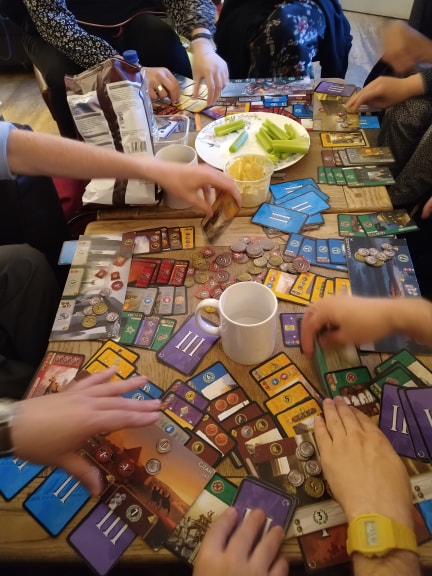
By the time the fireworks had ended, there was a good gathering of people, and as they kept streaming in the door we began a game of Monday night favourite, 7 Wonders. As always with Monday nights, there were a couple of brand new players, so I again didn't spring the Leaders expansion on them right out of the gate, but we had a good tight-fought base game, with one big science player, a big military build-up -thankfully on the other side of the board from me-, and a good smattering of big resource owners. I drew Halicarnassus, which I generally find to be a generally useless wonder unless you're going big in science or need to fight, so I abandoned building the wonder entirely and just focused on building a lot of yellow and blue cards, ended up becoming fabulously rich and carrying the day.
By this point in the night numbers were still going up, so we split into two groups, with eight people indulging in a couple of games of Captain Sonar while I led a five-player game of Paperback, which I always sell to people as a mixture between Scrabble and Dominion. As usual for a five-player game, this one took a while, but it rolled along at a pretty good rate with a whole host of good words being created, and when we finished I was a couple of points short of winning, with Luisa's high-value letters outweighing my solid card-drawing deck.
We finished the evening with a couple of silly party games of A Fake Artist Goes to New York and Elon Musk's iPod Submarine, which are both essentially the same game as Spyfall, where the players try to secretly communicate information to each other without tipping off the secret plant among them.Not normally my cup of tea, as they require too much creativity, but good fun games with the right crowd.
On the Screen
It's quite literally been a quiet week on the videogames front, as I've been more-or-less restricted to games that can be played without audio and can be easily paused or looked away from so that I can use my sight and hearing organs for important cricket watching activities. I've already talked about my forays into Opus Magnum, but I also played a little bit of Mini Metro and N++, games which I talked about last week.
I've also played and abandoned two different expert-level campaigns of Klei Entertainment's excellent turn-based stealth game Invisible Inc. I've been enjoying this one on and off for a while now, I've finished the campaign on the lower difficulties a few times and I think I've more or less reached my skill plateau, as I don't have the patience to wait for guard patrols that could potentially burst into any room each turn, so I tend to get my agents into sticky situations that I can't extricate them from. I still keep hitting that new game button, though, so even though I've stopped making progress it still has a hold on me, particularly late at night when my body has gone to sleep but my mind wants more.
Not a great week for the online mahjong either, with my Tenhou scores being 2-4-1-4. Though I had slihtly more positive results that negative ones, each 2nd place is only worth a quarter as many points as a 1st placing, so on average over the week I was down one game on aggregate. If it hadn't been for a bit of a resurgence over the weekenf it could have been a lot worse, though, so all hope is not lost yet.
I hope you found a little time to enjoy your hobbies this week.
As has become a familiar Blaugust story, I have once again let the backlog get ahead of me. In the first week, I managed eight posts, in the second, I only managed five. In this third week, which at this point is more than half-way done already, I've only squeaked out two posts. Last years effort looks remarkably similar, with seven, followed by five, followed by two, and only one post in the final week. 2017 was even worse, with seven, then four, then nothing else for a year. I guess I am nothing if not consistent in my inconsistency. Honestly the remarkable thing is that there were ever years like my golden age of blogging from 2014 to 2016 in which I managed to keep the pump primed all month.
While I hadn't intended to keep up daily posting when planning for this blogging festival, there's a reason that I start out each Blaugust that way, as I do tend to find that it makes writing a much easier hobby. Keeping up the daily routine keeps me honest, and for the most part once I've actually brought myself to start a post they've been coming out relatively easily, even though if I was being paid by the word I'd probably go hungry. Once I've had a day without posting at all then finding the time and motivation to write quickly becomes extremely haphazard and I'm much more likely to just let it slide again once there's no chance of winning Belghast's shiny trophy for that Blaugustines that manage 31 posts for the month.
Blogging in the comfort of the common room, with a cup of coffee close to hand.
So for the rest of the month I'm going to try writing first thing in the morning -when I wake up, anyways, sometimes that's still morning- instead of leaving it until later on as has been by habit so far. I'll have to put a time limit on my writing time so that it doesn't take up the whole day, which will hopefully enforce a little more structure on what has otherwise been a pretty free-form activity. Hopefully that will leave me time each afternoon to do the actually important stuff like packing up our house while I'm properly awake, as well as leaving more time in the evenings for catching up with all of the Oxfordians that we need to say goodbye to before we clear out of here. If I have free evenings, I am going to try to catch up a little bit of this backlog by posting a second time here and there, but looking at the schedule I'm thinking those days are going to be few and far between.
This week I had my first encounter with a satisfying little puzzle game that goes this really well, Opus Magnum, made by Zachtronics in 2017 -and therefore one of the more modern games that I've actually played, given that I have a big Steam backlog and a potato for a computer-. I'd seen mentions of Zachtronics games before, mostly in the context of them being a very small company that makes games for people that are smarter than I am. They made games like Space Chem and Infinifactory and Shenzhen I/O, games that are mostly about making complicated machines do complicated things.
Apparently not so daunted by this as to run off screaming, I loaded up Opus Magnum, and by two or three puzzles in I had three realisations:
One. I am terrible at this sort of game.
Two. I love this sort of game.
Three. It has .gif output.
Thus, to demonstrate why I am bad at this sort of puzzle, let me present some gifs.
The first is the final solution that I managed to come up for for one of the puzzles in Chapter III, where I was tasked to make a rope. My solution has three very basic moving parts. One rotor produces the ingredients and delivers them to a second arm which creates the basic structure, and a third arm on a track delivers the new segment to the rope. I think it's a simple, elegant solution, but as you'll note, this machine has a cost of 115, uses 264 cycles to run, and takes up an area of 54.
When you finish a machine, you're given some handy histograms to see how your machine compares to everybody else's. You'll see while my area is about as small as the most common solutions, there are people out there that have managed cheaper and much faster machines. I know that there are people all over the internet that can do all sorts of incredible things in video games, and I'm quite okay with never being one of them, but getting the histogram to the face each time I finish a level that I feel like I've done well in is quite a hit to the ego.
I haven't worried about optimising my machines very much. I'd love to say that this it just because it's my first play-through and that I'll probably go back and improve them later on. But the truth is that I probably won't. Because when I try to complicate things with clever mechanisms, things like this happen:
You'll notice that this gif isn't as nice and shiny as the last one, because I had to make it manually myself, as Opus Magnum doesn't give you outputs for machines that don't solve the problem. You'll also notice that in my attempt to make a machine with a smaller footprint but a slightly more complicated mechanism I have made too many many bonds. I have managed to -as they say in the business- goof it up. Even better, it almost looks right, so it wasn't immediately apparent to me that I hadn't solved the problem.
Basically, my issue is that I can more or less program one tool to do one series of complicated tasks, or many tools to do one simple thing each, as long as all those things either happen in sequence or happen all at once. But if multiple tools need to do complicated things at once, or to stagger their effect somehow, I just can't get the steps right in my head, and it doesn't seem to matter what I try, that sort of information just won't stay there. I can struggle through on trial and error, but not in a way that means I learn anything.
This isn't just limited to games, the same goes for real life, most notably sports. I can more or less run because it has a simple repeating cycle. I can play snooker or badminton because you basically just have to use the one arm at a time. I cannot play netball because I have to pay attention to not falling over, where I am on the court, where the other players are, and where my hands need to be so that I don't get hit in the face.I can't dance for the life of me, because you're supposed to move both arms and legs -and even, God forbid, hips- independently but at the same time.
I've come to terms with this. I play the sports I can and make attempts at games, even if I know that I probably won't be great at them and that I'll probably never be able to see the later levels unless I'm prepared to swallow my pride and resort to walkthroughs on GameFaqs or wherever it is the kids get hooked up with the pro gamer moves these days. That's fine with me. Except I'd really like to know how this one ends...
Just to add salt to the wound, it turns out that the puzzle I chose to demonstrate to you happens to appear in the Opus Magnum trailer. At 0:50 in this video, there's an example of a solution to the rope problem that I just can't begin to comprehend creating. It has five arms of three different types. Three tracks. It pumps out atoms so fast, and it does the final three steps simultaneously. Just...how?
Some people's Brains are incredible and can do incredible things.
As the eagle-eyed may have noticed by the suspicious lack of blog posts a couple of times this week, it's been a busy week here at Leaflocker HQ, and a busy week means a lack of the dedicated focused reading time needed to get really dug into the weekly readings. I was left with almost half of the planned pages still to read yesterday morning in order to get this post to you on time, and I didn't quite get there. To be honest, if it hadn't been for the rain interruptions with the cricket you'd have been unlikely to reading this at all.
After bemoaning having to read all the books off of a screen after the loss of my tablet last week, I did the sensible thing and just went the 50 metres across the quad to the college library to read my Plato and Herodotus this time around. Since even the masters students have flown the nest by this point in the year, I had the whole thing completely to myself, apart from the one fellow reader pictured above. He seemed very well-read, but wasn't very forthcoming with him opinions on Plato, so I left him in silence and went about my reading.
I still can't keep all my various Greek islands straight, but I guess that it's not really important in the long run. Things are heating up between the Greeks and Darius, and after the early sorties this week I think we can be looking forward to some serious fireworks next time around. I still don't know why the Spartans keep listening to the oracle, it's pretty clear to me that the Pythoness just doesn't have their best interests in mind.
Hey! This is where Aristophanes and his excellent story about how people used to have four feet and are now searching the world for their other halves comes from! I was not expecting that to pop up in the midst of these series of speeches in praise of love.
When we got to the main event of Socrates speech I was feeling pretty uninspired, since to my mind he started off with a pretty poor argument and it felt like he was going to stay on that track the whole time, but thankfully he moved on, and the argument about love as a creative force is an interesting idea indeed. Overall, I think this was the best of the Plato that we've read so far, and I'm looking forward to seeing what he has for us next time we revisit him.
Defoe is actually pretty good at action scenes, which came as a bit of surprise to me after so much of the action up to this point happening inside Crusoe's head. The attack on the cannibals that Crusoe has been fantasising about on and off for seemingly half the book so far finally happens, and with three to twenty-one numbers, the element of surprise carries the day. Reading the book digitally means I'm not completely sure, but we must be heading towards the end now, and while it's been a good time, I think we've probably experienced everything that Crusoe has to offer.
Another good one from Bacon. He seems to have his priorities in the right place, in this case his point is mostly that it's better to make conversation than to hold court and impress everyone with how eloquent you are. Normally I commend Bacon for his brevity, and while his packed a lot into one page, on this occasion I think he could probably just put the whole thing in a tweet.
After spending a couple of weeks complaining about the detailed descriptions of a throw-away house during the last volume, we open this one by returning to the house after all. Maybe I need to give Hugo more credit. That said, it still seems unlikely that we really need to know the detailed history and layout of the house, no matter who lives there, but let's wait and see.
The title 'Paris studied in its atom' didn't exactly fill me with confidence for there being a lot of plot development in today's reading, and indeed there wasn't any, but it was an enjoyable read. Hugo's detailed, passionate descriptions of the city are really something. Everything that exists elsewhere exists at Paris indeed.
So we come to the employment of Mr. Weller. It's got to be a change for the Weller, too, as it's just not Dicken's unless one of the characters in each scene talks with a weird accent #punachieved. I can't say that I got a whole lot out of Pickwick this time around, it mostly just washed past me, but hey, there's a lot of chapters and they can't all be winners.
Some Numbers:
This week we passed the 1000 pages of the Great Books of the Western World series read. We also passed 100 pages of philosophy and theology dialogues spread over six different titles, 5 of which are the various Platonic works that we've finished. But never fear, there's plenty more where that came from, as we still have eight Platonic dialogues to get through, not counting the twelve that we discarded during the great notoriety cull at the beginning of the project.
Pages last week: 114
Pages so far: 2803
Readings for Week XXV:
Thanks to an absolutely gargantuan reading from the Histories, we're left with just enough room for three other titles to keep it company. Alongside excerpts from Defoe and Hugo we're going to take a risk and have a shot at George Santayana's Lucretius, because at some point we have to tackle Lucretius anyways, and also because Santayana famously said that thing about the past and being condemned to relive it. You'd have thought after the Emerson debacle I'd have learnt about picking books just on a pithy quote or two from the author, but I guess I have always been slow to learn, and I'm not going to change the habit of a lifetime after just one somewhat perplexing dive into modernism.
Dr. J, whose reading plan I am using as my starting line, also read D.H. Lawrence's The Rocking-Horse Winner, but he didn't have Sons and Lovers on his list like we do on ours, so I figure we can skip this one and hold out for the main event. It's a busy enough week as it is.
It's Wednesday, so that means it's time for the Monday quiz. Congratulations are due to John, Bhagpuss and Ale for braving last week's quiz and for your scores of 7,5 and 5 respectively in what I'd thought was an extremely challenging week. For those of you who missed out, feel free to pop back to last week's quiz and try your luck before coming back and checking your answers below.
1. The last Aztec New Fire Ceremony was held in 1507. I am glad I was able to ensnare one person in the classic Aztec/Inca coin-flip. 2. The painting I was looking for was Da Vinci's Mona Lisa. Full marks to all. 3. The sculpture I was looking for was Michelangelo's David. Can you believe it was carved out of a piece of marble that no-one else wanted? 4. Columbus used a lunar eclipse to wow the people of Jamaica. Columbus was strictly an Atlantic Ocean guy, but I agree that the etching does have a Pacific vibe. 5. Dias was the first European to set foot on Madagascar, but pretty much everyone else beat him to it. 6. Pictured were the colourful outfits of the Swiss Guard, who've been protecting the Vatican City from crimes against fashion since 1506. 7. Guru Nanak found the founder of Sikhism. I knew nothing about Sikhism a couple of months ago, but it keep popping up all over the place at the moment. 8. Henlein's 1505 was the first watch, not technically a wristwatch but it's the idea of portability that's important, so I'll pay Ale the point. Clockwork itself is much older. 9. The garden of Earthly Delights is a Triptych. I thought this was a pretty hard question, but you lot are hitting the art ones out of the park this week. 10.The Atlantic slave trade began in the 1500's and continued until the 1870's. John was right on the button.
With that excellent showing I'm expecting some very impressive results in your comments this week as we dive in the 1510's, but as usual we appreciate the effort of giving in the good old college try rather than actually happening to arrive at the correct answers.
The Quiz
1) Who is pictured here, possibly apocryphally, in 1517, casually starting the Reformation?
2) From where were sunflowers, which have been domesticated since at least 2500BC, first brought to Europe in 1510?
3) Which astronomer, who wouldn't widely publish his theories until 30 years later, contradicted Ptomely's model of the universe in his Commentariolus in the early part of the 1510's?
4) In 1517, the Mamluk Sultanate was defeated by the Ottoman Empire, leading to 350 years of Ottoman rule of which modern-day country?
5) Which artist, who had never seen a rhinoceros, produced this woodcut in 1515 from a written description and a sketch from another artist?
6) Which modern capital city was founded by conquistador Diego Velázquez de Cuéllar in August 1515?
7) Which Archbishop of York was appointed both Cardinal by the Pope and Lord Chancellor by King Henry VIII of England in 1515?
8) Which political treatise, not publically available until the 1530's, was written following the author's arrest and banishment from Florence by the Medici family in 1513?
9) The Portuguese conquered Goa in 1510. We all know and appreciate the tight Euro strategy game with the same name, but...in which country is Goa, actually?
10) Considered one of the most important works of the Northern Renaissance, In Praise of Folly, published in 1511, was the work of which humanist?
If, like me, you've been trying to keep up with the Blaugust posts this week, then you'll have noticed a few iterations of this little 'seven questions' LiveJournal-style meme floating about. I never had a LiveJournal, but I absorbed the content of quite a few of them back in the day, and when I gt around to making a blog I tried to keep a lot of the personal day-to-day nature that seemed to ooze out of them, as I remember how much I enjoyed seeing those little glimpses into people's day-to-days, and the ups and downs of real life. Remember when we called these viral things that travelled from blog to blog memes? I must have sent the answers to hundreds of these questions to various friends over the years. I hate to think what dirt sort of them must have on me, should I ever lose my marbles enough to attempt to run for public office. These questions appeared on Naithin's Time to Loot blog earlier in the week, and I thought it would be a good topic, both for my weekly response to Blaugust post and also for 'Getting to Know You' week. I hope that you get a little peek into my life through it and that you find a little enjoyment in getting to know me a little better. Feel free to ask more questions if you feel it drags any up, too, there's few things I enjoy more than talking about myself, after all.
What hobbies or interests do you have that you might not regularly include on your blog? The part of my life that takes up the most time but goes mostly under the radar here on the Leaflocker is probably my faith. From the blog I imagine that people would get an idea that I spend all of my time playing games and generally lounging about, and while that's not a completely inaccurate assessment, I also spend a significant amount -though never as much as I'd like- of my time reading and praying, and for most of the life of the blog I've been working in churches too.
The beautiful College Chapel has been an important place of meditations and reflection for me in recent years.
I've tried to share some Christian stuff on the blog here and there -last Blaugust one of my weekly topics was going to be the homilies that I've planned or preached for our college chapel- I've generally found that I have to work very hard to make it work. Somehow the tone and flow that I have here doesn't work for it. Maybe it's just that I do take my faith seriously and the blog is a casual pursuit with a pretty high level of irreverence that doesn't suit it. The same can be said for my daily life, though, I'm not a very committed evangelist because I struggle to make room for my faith in my daily conversations unless I'm really working at it, so it's not just a blog thing!
Are you learning any skills at the moment? If not, what would you like to learn?
I've done a little bit of self-taught book-binding here and there, and that's something that I'd really like to spend a bit more effort committing to on a larger scale. It's a relatively easy way to make something beautiful and personal, and as someone who is terrible at giving gifts but likes to keep busy it seems like a perfect hobby to get me out of the constant bind of wondering what to get people for birthdays and weddings.
Ultimately by the end of the Great Conversation Project I'd like to be able to make my own hard-bound versions of the books that make my own personal canon and have a whole shelf of matching books that I've printed and bound myself, but that's a pretty long-term goal, and not just because the Great Conversation is currently looking like running for about 70 years.
If you were invited on a one-way trip to Mars to establish a new colony, would you go?
I think so. Living away from home for a while has shown me that while I do suffer from homesickness, often pretty severely, it's a feeling that can be mostly mitigated by the occasional long-distance call passes and that doesn't get in the way of getting on with life. I'd be more likely to go if I could take, oh...a couple of hundred of my favourite people with me, but I suppose if you're selected for a one-way Mars mission bringing that sort of luggage isn't really an option.
You also have to wonder what kind of Mars mission would consider me as a candidate. Presumably you need people with specialised skills, a high level of fitness and a single-minded passion to see things through, and I am not remotely qualified in any of those areas. If their screening process lets me in, I'm not entirely confident that I'd feel comfortable trusting that the mission leadership are qualified for the position and I wouldn't expect our new colony to last very long.
That said, I'm generally alright at giving unfamiliar things a good solid try, I don't mind a bit of hard work and have a can-do attitude and a sense of prioritising the communal good that could be useful on a Mars mission. I also don't really own very many things and aren't that attached to the things that I do, and don't really need creature comforts that aren't caffeine-based, so there's no worry about that. I try to be generally likable and am pretty confident that I am at least a lot less annoying than I was in my youth. So they could do worse. Pick me, pick me!
What is the one thing that you most want readers to come away from your blog with?
I'd like folks to go away glad they'd visited and a desire to learn more. Whether it's a book post or a game post or a bit of nonsense, I want people to have wanted to keep reading when I reach the conclusion, to have found a line here or there to have brought a smile to their face, and to have an overwhelming desire to open a wikipedia tab and look into something fun that I mentioned in passing. Basically, I try to convey the idea of a comfortable friendly late-night conversation with a dear friend, with laughter, a little bit of off-topic rambling, and the sort of atmosphere where you could bring up something important to you if you needed to, knowing that I'd listen and care. I'm not sure the blog goes there most of time, but that's the sort of vibe that I shoot for. What excites you most about having a blog?
The most exciting part is when you've run with an idea and managed to turn a blank page into something that someone might actually want to read. There's a moment when you're about half-way through when it suddenly just clicks, you can envision a potential reader being carried along with what you're writing and just nodding as they scroll. That's a good feeling. It's usually followed by the recognition that actually, on second though, this is utter nonsense, but every now and then it's not, and even when it is the original feeling is intoxicating enough to keep me coming back for more.
If you could make one thing from a book, TV show or movie real, and in your possession, what would it be?
If I owned a sonic screwdriver, I wouldn't need to remember my house keys, and I'd be employable in any number of services, identifying and fixing mechanical problems. I think it'd be a pretty good excuse to get to look around interesting places and a fun toy to just play with when I have a quiet moment. Also, I could make that really annoying woowoowoo noise and drive any dogs in the area completely nuts, so that'd be a big win, I reckon.
They say everyone has at least one book in them — if you were to write a book, what would it be about?
I still want to write that comic-book about time travelling popes. I still can't draw, or write, and don't have any really solid ideas for it, but I am still 150% committed to the idea of being a person that is one day going to write a time travelling pope book.
Usually one ends this sort of post by tagging other people that should answer some questions, but I've always found that sort of thing the least attractive part of the whole process. I like talking about myself, but I also like throwing these words out into the ether to the nameless internet rather than to any particular individual. If you've read this and you feel the need to respond, that makes my day. Take that energy and turn into a blog post that leaves people with an insatiable urge to open a wikipedia tab.