Tuesday, 2 August 2016

Curious and Unaccountable Things

I don’t read enough books. So I set myself a silly goal of reading 'all' the great books of western literature over the period of the next decade or so.

Even though I had a relatively light few days, it was quite the struggle to get through the reading that I’d set myself to finish off this week. Not having most of these books in paper form and having my Kindle out of action at the moment means that I can only read when I’ve got my computer open, and there are so many distractions…

This Week:

The Odyssey of Homer
Books XVII-XX

The bit with the loyal hound was less moving than I remember, which is probably why there's so few decent allusions to the scene in the art world, but I think it's still important in the zeitgiest of the Odyssey. All the half-way decent bits of Homer have some decent art, so Argos is really missing out, by my reckoning.


In these chapters Odysseus begged food off some suitors, beat up a bum, bullied some maids and repeatedly lied to his wife while pretending to be a hobo, which are the sort of par-for-the-course things you do if you’re a Greek hero.


I found it interesting how Athena repeatedly works in these chapters to make the suitors seem worse than they might otherwise be in order to goad Odysseus into killing them, and also works to ensure that none of them have a change of heart and leave before things get real. A nice reminder that Greek gods have a lot in common with their heroes. I can’t help but feel sorry for some of the suitors who seem to have good intentions, or at least the inclination to act decently. Doesn’t seem to matter, though, they’re all going to get the chop.

Book XX ends with a nice little bit of set-up for what is to come: ‘The dinner indeed had been prepared amid merriment; it had been both good and abundant, for they had sacrificed many victims; but the supper was yet to come, and nothing can be conceived more gruesome than the meal which a goddess and a brave man were soon to lay before them, for they had brought their doom upon themselves.’

Of Friendship by Francis Bacon

Again with the smattering of Latin just to make life difficult for the non-Latinists among his readers (admittedly probably a small number in this day and age), but this time I could just about puzzle out the meanings. 

Bacon disagrees with Cicero that true friendships can only be had between equals, but admits that it’s hard for leaders to find true friends. He sees the benefits of friendship in helping to ease burdens of the mind, having another mind to help solve problems, and someone to help do things that one can’t. That all seems fair enough to me, but seems a bit cold; I’m sure there’s something in friendship for friendship’s sake that Cicero got but Bacon is missing out of.

What most interested me reading this in the wake of introspective Blaugust posts by a number of my friends over the last couple of days is how much importance Bacon puts on talking to someone about what's going on in your life: 
'Neither is this second fruit of friendship, in opening the understanding, restrained only to such friends as are able to give a man counsel; (they indeed are best;) but even without that, a man learneth of himself, and bringeth his own thoughts to light, and whetteth his wits as against a stone, which itself cuts not. In a word, a man were better relate himself to a statua, or picture, than to suffer his thoughts to pass in smother.' I find it encouraging to know that so many of my friends are talking about some of their deepest worries, their struggles with depression and illness and relationships. That Blaugust has been an opportunity for some to air their thoughts, not just to the ether but to a sympathetic audience, makes me happy and I think it would make Bacon happy too.

The last section has some real corkers of quotes, but I think the most applicable to my life right now has to be one which conveys the thoughts that sneak into my head with regularity when when reading philosophy like Bacon's:  ‘Reading good books of morality, is a little flat and dead.’

Les Miserables by Victor Hugo
Book Five, Chapters I to IV

Surprising nobody at all in the world, it turns out that the big twist was Monsieur le Maire is... Jean Valjean! I am shocked, shocked I tell you! I had to work pretty hard to stop myself from reading ahead this week, and only the knowledge that I hadn’t done my Euclidean reading yet and had a deadline to meet convinced me to take a break.

Elements by Euclid
Book II

Well, all I can really say is that I'm trying, but I find Euclid's language extremely inaccessible. If it weren't for the guide to read alongside the translation I'm pretty confident that I wouldn't be getting any of this. With the guide, almost all of it seems vaguely managable, I think I've got it all down, more or less, though I'm pretty lousy at making my gnomons work for me and I'm not having much fun doing so. I suspect that I'm not internalising all these propositions enough to be able to properly use them later on. Maybe I need to write more of them down, or something? Certainly I need to stop approaching Euclid late at night.

So many of these rules seem self-evident to someone with a basic understanding of geometry, but I probably have that from what my betters have managed to learn from Euclid, and I guess self-evidence is not enough for a mathematician after all.

I should really pay more attention to designing concise proofs. I always was lousy at making proofs.

Brave New World by Aldous Huxley
Chapters 1-3

My recollections of Brave New World from having to study it (ok, I didn’t have to study it, I suppose, but I chose to anyway because I was just that sort of kid) were that I hated this book with a passion, but on this attempt I’m not getting those vibes so much, at least not yet. Yes, the storytelling seems lazy in the extreme, just dumping all this background on us effectively in monologue form, but for now I’m alright with it, the somewhat clinical nature of it really does seem to suit the setting down to a T. #punachieved

The multiple threaded conversations thing still gets my goat, though.

The Stats

This week we passed the milestone of 200 pages of epic poetry, and also 200 pages of Homer… I suspect the two may be related. By the time we finish the Odyssey next week I’ll have read more Homer than anyone else except Dickens during the project (and that’s a close run thing), as we’re about to go steaming past Nabokov.

Pages last week: 123
Pages so far: 1228

Week XXII:

This week we substitute Montaigne for Bacon, and slip a little Americana in there on the side, but apart from that we’re looking at a pretty similar looking week to the last one. There won’t be much time to really get into our groove, though, as this will be the last time that we revisit the Odyssey.

The Odyssey of Homer
#gbww #fiction #greek
Books XXI-XXIV (48 pages)

Time to finish up the Odyssey and finally put the first of our really decent-sized classical works to bed. It’s about to get real. Time to get rid of some suitors, make up with the wife and get good with the gods, methinks.

Elements by Euclid
#gbww  #mathematics #greek
Book III (25 pages)

I’m still struggling with the Elements, and that fact that this book is larger than the two previous can’t possibly be good news on that front. Wish me luck.

Death of Abraham Lincoln by Walt Whitman
#new #ggb #lecture #english #short
(10 pages)

This is apparently a transcription of an annual lecture that Whitman used to give on the anniversary of Lincoln’s death. We get to read Whitman’s magnum opus Leaves of Grass later on in the project, but I don’t think I’ve ever heard of him as anything other than a poet, and Whitman wrote the familiar O Captain, My Captain on the same topic, so I thought it might be an interesting diversion to try out his prose a little.

Of Idleness by Michel de Montaigne
#new #gbww #philosophy #french #reallyshort
(2 pages)

We return to Montaigne and actually get into some content this time. Time to see what all the fuss is about after that weasely little introduction that he foisted on us a few readings ago. It might be interesting to contrast him with Mr. Bacon, the other philosopher we’re reading bits and pieces from every now and then.

Les Miserables by Victor Hugo
#not_gbww #fiction #french
Book Five, Chapters V to VIII (12 pages) 

I’m starting to regret digging into Brave New World just because that having it in the line-up is making us take Les Mis in such small bites, and Hugo waffles aren’t really made for nibbling, but better consumed in large, melancholy gulps. I can only assume that at some point in the near future M. le Maire will meet our dear Fantine, but who really knows?

Brave New World by Aldous Huxley
#new #not_gbww #fiction #english
Chapters 4-5 (22 pages)

I find my mind refreshingly blank on details of what comes next in Brave New World, but I can only assume that Lenina and Bernard hang out a little and we get to find out a little more about Bernard’s bizarre non-conformist tendencies.

I’d love to have company reading one or more of the texts that I’m setting out to tick off of the list this week, so if you’re keen to join in, do let me know.

Blaugust writing prompts:
1) What have you been reading?
2) Have you ever hated something when forced to study it, but had it grow on you later?
3) How have you tried to expand your horizons lately?

Monday, 1 August 2016

A Brazen Soul

If you're here for Blaugust, you've come to the right place, but if you're here to get the lowdown on video games, I'm really not your guy. The Leaflocker strays into video game territory now and then, but we tend to march to our own drum. Since you're here, I hope you enjoy the rhythm.

For almost a year now, I’ve lived here in the dreamy tourist town of Oxford, and I figure that it’s just about time that I actually get around to doing some of the touristy blogging that I’ve been promising folks back home that I would get around to doing eventually. This feels a little weird, as I’ve been here so long that I don’t feel like a tourist any more, or at least I don’t block traffic like all those naughty tourists out there in the square frustrating the locals. In a sense Oxford is the sort of town that just has SO much history that even people who’ve lived their whole lives must feel like they’re just skimming the surface on a quick visit, so maybe we’re all tourists, and I figure that until I’ve done a good bit of poking about, at least in most of the colleges and museums and things, a duty that I’ve been a little lax in fulfilling, then I definitely have a licence to do the tourist blogging for a little longer.
Brasenose Old Quad - with some humans messing up the view
It seems appropriate to start with my own college of Brasenose, for two reasons. One is that being a member of the college I don’t feel that awkward sense of the embarrassment of being an outsider whenever I raise my camera inside college grounds, meaning that it’s one of the few Oxford locations where I’ve actually taken half-decent photographs (though I was able to find worrying few when compiling this). The second reason is that it seems timely to offer up this post as a sort of tribute, as this weekend I bid a fond farewell to my dear friend Charles, kindred spirit and our Brasenose mentor, who to my mind invokes the very essence of the college. Charles isn’t dead or anything, but he’s going down to take up a Ph.D. at Cambridge, something any Oxonian (and Charles himself, at least prior to drinking the punch presumably spiked by errant Cantabrigians) would gleefully tell you is a fate worse than death.

That’s one of the wonderful things about Oxford. It’s exactly what you expect. In the rarefied air of Oxford, the Harry Potterisms, quaint traditions, senseless rivalries and genteel snobbery pervade everything, but Oxonians are refreshingly honest and open about them. They’ll disparage their fellows ‘from some insignificant place North-west of here’, but drudgingly admit that at least they’re better than, well, anyone else - the poor souls just weren’t fortunate enough to come up to Oxford. They wouldn’t dream of getting rid of sub-fusc, the strange gowns-and-bow-ties uniform of the middle ages that students gladly pull on for any and all formal occasions, including exams, because that’s how it’s always been done. In many ways, Oxford and the Oxford student, particularly classicists like Charles, are the champion of a bygone age. Not to say it hasn’t played a critical part in progressive thought over the centuries, that is what education is all about, after all, but let’s not get ahead of ourselves.

Oxford was already a flourishing town at the time of the Norman Invasion (that’s 1066 AD, for those playing along from home). Thanks to some handy concessions, it quickly became a centre of scholarship. Hundreds of small academic halls sprung up to house and educate the ‘poor and indigent’ scholars. Some of these residential halls were more successful than others, and Brasenose Hall slowly grew, and grew, and took over their neighbours so that they had more space to store all those irritating student types that kept showing up. As much as Charles would insist that the real glory days of Brittania ended when the Romans left, the period following the Norman invasion really was a period of great population growth and improvement of the quality of life in England, and Oxford's handy location put it in a great position to take advantage.

Brasenose Hall - the knocker is just under the portrait of the bishop
Named Brasenose after their distinctive brass doorknocker, the Hall even survived some of their students walking out in the mid-14th century and stealing the doorknocker away to start their own rival Brasenose Hall in Lincolnshire (one can only assume they it allowed blackjack and hookers, the sorts of things that conservative Oxford would have frowned upon). Brasenose has a long memory, though, and when their rival Hall went up for sale more than 500 years later, the college bought the property just to regain the doorknocker, which now sits in pride of place above the Principal’s chair in the college hall. It doesn’t do anything, it’s just there. Personally, I think for a place with as many time-honoured traditions as the ‘Nose, there really ought to be some kind of knocking ceremony, but maybe I’m just not invited to the right sort of parties.

Though Brasenose had been around for a while, it only officially became a College with a capital C when it received its royal charter in 1509, 13th among the 44 colleges and halls still in existence today. It had a reputation for traditionalist values from the very beginning, being dominated by Catholics during the Reformation (six of the fellows were executed and many more dismissed for their papist tendencies) for, the Cavaliers during the Civil War. (the royalist principal of the time locking himself in his lodgings and continuing to direct the affairs of the college despite a new principal with more politically fashionable views being appointed), and the Jacobites during the reign of George I (stirring up riots in Oxford - students never change, do they?). Back in the day, the scholars would mostly have studied theology, but as the middle-ages wore on and Europeans rediscovered the Latin and Greek authors, classical studies (or ‘real studies’ as Charles would say), became more common. Later still, the sciences started bring studied to, but as undoubtedly our good friend would say that that’s when the rot set in, we’ll not mention them further.

New Quad and the college chapel - courtesy of  Fran because my photos suck
The Brasenose that you can see today is clearly the product of this historical identity. The Old Quad was finished in the 17th century, built in a period of booming student numbers, stands on the site of the original halls, and the oldest and grandest of the rooms in the college, including the original library (now creatively called the Old Library) and the Hall date from this period. After that, the college expanded upwards, adding a second, and eventually a third level to the quad to accommodate students when financial woes would have made the addition of new buildings or the acquisition of new grounds prohibitively expensive. As you might imagine, this means that student rooms (or sets, because apparently students are badgers?) are pretty various in size and quality, some of the nice ones like the fancy one Charles is always bragging about, are bigger than our two-bedroom apartment and come with all the mod-cons, and some people kind of miss out. But hey, at least they get a bed, I guess. During a period of puritan tastes the decidedly extravagant Chapel was erected, the dignified Oxford principal’s equivalent of blowing a great big raspberry at the current government. I’m sure there are interesting stories to tell about the erection of the New Quad at the turn of the 20th century, but as that’s the domain of undergraduates I don’t tend to venture over to that side of the college.

Brasenostrils (yes, that’s the official term) haven’t always been old-sticks-in-the-mud, though. We were also one of the first colleges to admit female students in a tradition that had only enrolled men for the preceding 700 years, which can’t have been an easy step for anybody involved in a place that takes its traditions so seriously. As to traditions, well, there are some corkers, but I think it’s probably best to leave them to the posts of their own that they so richly deserve and simply say that you’re in for a treat if I ever get around to writing about the Ale Verses or Ascension Day. These traditions are lovingly handed down amongst students from age to age, and the stories naturally conflate with the telling to such an extent that it’s hard to know what’s true and what’s not, but it does make for some wonderfully strange rituals.

All this combines to make a humble, egalitarian place of learning where we’ve felt very much at home since first arriving in Oxford, not the sort of inaccessibly formal place that I was expecting before I came. Yes, I can’t help but be constantly struck by the reserved, dignified, almost ethereal beauty of the place, and the absurd stuffiness of some of the rules is simply infuriating, but the college is undoubtedly our home-away-from-home, a place to relax, drink pots of tea and shoot the breeze with the fellow students that have become our treasured family while we feel so isolated from our folks back home in Australia. Charles, with his anecdotes about Roman legionaries and Aristophanes fart jokes, wasn’t the first person to make us feel at home here, and I’m sure he won’t be the last, but I can’t help but feel that there’ll be a little part of Brasenose that will always be missing for me from this point forwards.


At least he’s an alumnus now, so he’s sure to come back now and then if only to sample the generous meals the college regularly puts on for Old Brasenostrils. I hope the next one is soon, I miss him already.

Blaugust writing prompts for those who need a little prodding:
1) What has changed about your life in the last year?
2) Have you ever met someone and just known that they were a kindred spirit?
3) What have you learnt about your local area lately?

Sunday, 31 July 2016

To Break All Bodies

With Blaugust starting tomorrow, it seems appropriate to fall back on an old Leaflocker standard (read: I like it but it’s reader poison) and present the next part of the Up Goer God Book, the ongoing project of my good friend PsephologyKid to translate the King James Bible into the ten hundred most common words in the English language; for the lols. Since the original release of the first five chapters of the Book last year, Randall Munroe has made a considerably nicer word list that he used for his book Thing Explainer available, so I’ve done a little sprucing up to make chapter 6 TE-compatible.

As always, making the devotional cards for this has been a blast. I let the random number generator pick a verse for me to attempt to illustrate, and also just picked a couple manually because the random number generator just can’t be trusted to pick the best ones and I’m not under the Blaugust content pump just yet.

1 And it came to pass, when men began to have children on the face of the world, and daughters were formed by them,


2 That the sons of God saw the daughters of men that they were hot; and they took them wives of all which they wanted.
 3 And the god said, My mind will not always work with man, for that he also has body: yet his days will be an hundred and twenty years.
 4 There were big people in the world in those days; and also after that, when the sons of God came in to the daughters of men, and they formed children with them, the same became strong men which were of old, men well known.
 5 And God saw that the bad wants of man was great in the world, and that every idea of the thoughts of his heart was always bad.
 6 And it made the god sorry that he had made man on the world, and it made him sad at his heart.
 7 And the god said, I will kill man who I have made from the face of the world; both man, and animals, and the quietly moving thing, and the flying animals of the air; for it makes me sorry that I have made them.
 8 But "No are" was found good in the eyes of the god.
 9 These are the children of him: he was a just man and perfect in his children, and he walked with God.
 10 And he formed three sons, "Share Him", "Him", and "Jump Hairs".
 11 The world also was not good before God, and the world was filled with hurting each other.
 12 And God looked upon the world, and, check it out, it was not good; for all the bodies had broken his way upon the world.
 13 And God said to "No are", the end of all bodies is come before me; for the world is filled with hurting each other through them; and, check it out, I will kill them with the world.
 14 Make a water car of wood named like a ground breaking animal; rooms will you make in the water car, and will paint it within and without with black old dead tree water.
 15 And this is how big you will make it: The long side of the water car will be three hundred fingers to arm joins, the wide side of it five ten fingers to arm joins, and the tall side of it three ten fingers to arm joins.
 16 A window will you make to the water car, and in a fingers to arm joins will you finish it above; and the door of the water car will you set in the side there of; with lower, second, and third stories will you make it.


 17 And, check it out, I, even I, do bring a lot of waters upon the world, to break all bodies, where in is the breath of life, from under the place I like; and every thing that is in the world will die.
 18 But with you will I make my promise; and you will come into the water car, you, and your sons, and your wife, and your sons' wives with you.
 19 And of every living thing with bodies, two of every sort will you bring into the water car, to keep them living with you; they will be boy and girl.
 20 Of flying animals after their kind, and of food animals after their kind, of every quietly moving thing of the land after his kind, two of every sort will come to you, to keep them living.
 21 And take you to yourself of all food that is eaten, and you will bring it to yourself; and it will be for food for you, and for them.


 22 In this way did the water car man; following all that God told him to do, so did he.


See, you can turn almost anything into moderately acceptable blog content, it seems, it's easy! I’d love for you to join me over the next month joyful communal blogging. Pick a pace that you think might work and get typing. It’ll be fun, I promise. Catch you tomorrow for the beginning of Blaugust. Same bat time, same bat channel.

Tuesday, 26 July 2016

You Must Get a Hold of Me

A quick look at my calendar confirms that the rumours are true, July is basically finished already, and that means that if I’m going to get back in form for the annual festival of frantic typing and fevered late-night web-trawling that is Blaugust it’s about time to dust off the old typewriter and get back on the blogging bandwagon for another year. I get the feeling that Blaugust is going to be a real struggle for me this time, but a boy has to try. Heck, it can hardly be worse than some of my lacklustre attempts over the years, can it?

What better way to begin the ride with a return to my long-running, oft-neglected attempt to read the Western Canon one little chunk at a time? At last count, each ‘week’ of this theoretical 7-year project has taken an average of just under three months, but here’s hoping that the next month or so can improve that average a little.

This Week:


The Odyssey of Homer
Books XIII-XVI

Well, Poseidon is really not the kind of guy that you want to piss off. And he’s definitely not the sort of guy that you want to be pissed off by one of your casual acquaintances, is he? I do think there’s an awful lot of irrelevant nonsense that could have been cut from these chapters if Homer had a decent editor. Odysseus so much time hanging out with pigs, trading stories with and telling lies to loyal retainers, Eumaeus well wonder if he’s completely lost all his marbles. #punachieved

Phaedo by Plato

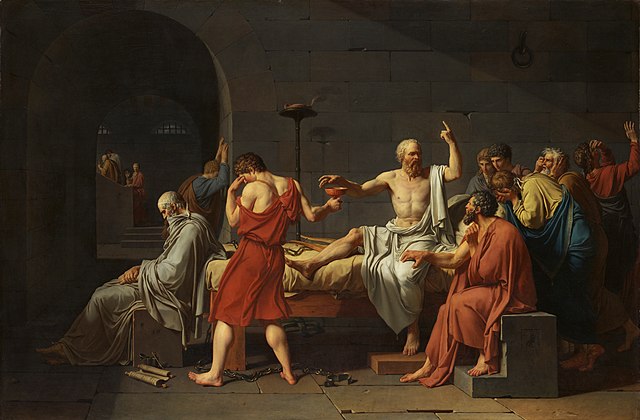
So, we come to the end(?) of the Socratic dialogues. Meno was unintelligible, the Apology was grand comedy, and Philo featured some great arguments. How does Phaedo stack up? Well, in some ways it’s a bit of a summary of the greatest hits of the others. Socrates is less of a jerk, as he’s among friends, but he still a bit of a smarmy git, and some of the ways he argues, like the way that he dismisses the others’ similes as just similes but presents his own as facts, are just plain annoying. For me the strongest parts are the bits about the nature of death and the soul (most of it, I guess!).

Socrates is also pretty hilarious in this one. His friends are all weepy and worried about the future, and he’s cracking some great lines: “And in what way shall we bury you?” “In any way that you like; but you must get hold of me, and take care that I do not run away from you.”
What a card he must have been.

There’s some other great lines in there too, and of course there’s final words of the greatest Western philosopher. Classic. Overall, I don’t think “the one with the chicken” was as good as Philo or the Apology, but it’s totally worth the read for the interesting insights into the way that the Greeks saw the world, and also just to finish off the story with a bang.


Elements by Euclid
Book I

I don’t think I’m going to enjoy reading Euclid very much, which is a little bit of a pity, because if I keep up with the project he and I are going to be acquaintances for quite a while. Quite possibly just becoming a little bit more familiar with how the whole thing is set out is going to make my life easier. Reading it with the guide open as well is pretty handy, as I often want to check the processes of my own modern mathematical brain, and it seems to provide a helpful hand for that. Still, this is the first distinctly different work on the list, a mathematical treatise is definitely not a Socratic dialogue, and I admit to finding the idea pretty interesting in theory, even if the practice leaves me a bit cold so far.


There are a lot of familiar words here, and for good reason, the Declaration is a moving piece of writing. Much of its power comes from the fact that it just seems so reasoned and deliberate, so divorced from the political discourse of today that it just makes you yearn for some real statesmen. Sadly, I feel some of its power is diluted by including in the list of grievances acts committed during the war in the document that was supposed to be listing reasons for the war, but I suppose this is a minor quibble about what is otherwise a scintillating historical document. Definitely worthy of canon status.

Next Week:


For those that don’t recall, we’re following along with the reading list provided here, a few years behind (but the project looks to be abandoned, so we’re actually catching up extremely slowly). I take the weekly readings from this list and subtract from and add to them based on a combination of my secret spreadsheet, special sauce, and weekly enthusiasm level.

This weeks readings were to include the US Articles of Confederation, which is in the Great Books (unsurprisingly, the project was unapologetically focused on Usonian studies) but I’ve cut these since almost no-one else thinks they’re important to read. From the Gateway series, I’ve also cut a letter by George Washington that looks pretty unimportant, as well as something minor from John Stuart Mill, we’ll be getting plenty of him later in the project so I don’t feel particularly compelled to jump right in now. On the other side of the ledger, we have the return of Les Mis and the advent of a little more modern sci-fi.

The Odyssey of Homer
#gbww #fiction #greek
Books XVII-XX (48 pages)

I think the chances are about 50/50 that Odysseus actually gets around to doing anything in the next four chapters. There’s suitors to investigate and a wife to carefully avoid, after all, plus he has to make room to tell some more unnecessary pork pies, because he’s Odysseus and that’s just how he rolls. And gosh doesn’t Athena just love him for it?

Of Friendship by Francis Bacon
#new #ggb #reallyshort #philosophy #english
 (2 pages)

When was the last time we dipped into Bacon? I don’t remember being particularly impressed last time, but let’s see if Friendship makes for a better topic for Bacon to really get his snout into than whatever unmemorable thing we did last time. This quickie represents our only philosophy for the week, so I hope that it is at least vaguely philosophical.

Elements by Euclid
#gbww  #mathematics #greek
Book II (21 pages)

After the joy of last week discovering some of the properties of lines and circles, I bet you’re all just gagging to experience the wonders of Euler’s geometric algebra. Sounds thrilling, I know. All this maths reminds me of first-year high school, and while the memories are generally positive, I don’t feel like I want to dwell on them.

Les Miserables by Victor Hugo
#not_gbww #fiction #french
Book Five, Chapters I to IV (16 pages) 

When we last dug into Les Mis, Fantine had been forced to leave her daughter behind with some generally horrible people in order to be able to work enough to put food on the table. I expect in the next chapters the actual sad stuff starts, and it’s unlikely to let up for a while. Such a cheerful book, this one.

Brave New World by Aldous Huxley
#new #not_gbww #fiction #english
Chapters 1-3 (36 pages)

Since we needed to fill a few more pages this week and I felt the duel need for something a little more modern and something I could easily get my hands on in paper form, we’re also starting up another novel that is on many lists of the most important books but that I personally have never found very interesting. Let’s find out if not having to study the thing for classes makes it any more enjoyable. It is also available online, though, so just because you don’t have a paper copy like I do doesn’t mean that you’re excused your reading homework.

On that note, please do feel free to join in on the fun by reading along with some selection of this week’s texts if you’ve half an inclination. It’s always good to have company and someone to force me to really think about things instead of just skimming over the good stuff.


Speaking of company, it’d be great to have some fellows along the mad little Blaugust road, too. If you’re interested in joining in, all you have to do is make a plan to post something, anything, during the calendar month of August. Challenge yourself, explore the possibilities. I’ll be hoping to aim for daily posts again, but weekly would be fine too, aim high and fall gloriously short if you have to, it’s more fun that way. Let me know in the comments so that I know to look out for your stuff.

Friday, 13 May 2016

Board Report: Cartagena / Robo Rally

The problem with letting the blog get out of date at the moment, apart from the intense embarrassment and shame I feel in failing my loyal reader yet again, is that there's just so many games that I want to share with you all. Normally the need to blog is the thing that drives me to complete projects, but games keep happening and the writing lags behind, and that's just not on. Here's just a little taste of what I've been playing lately.

Cartagena

The ever-reliable Ian keeps bringing new and interesting games along to Wednesday for me to try, and he keeps hitting pretty close to the mark. Personally, I suspect that he's building up a database of my gaming predilections in order to replace me with a game-playing automaton, but what's a girl to do?

Cartagena is an elegant little race game, in which players need to push their crew of five pirates through a labyrinth to their waiting row-boat. The mechanics are simple, pirates can move forward though the passage to the next empty space displaying an item represented on one of the cards in their hand, or backwards to the closest group of other pirates in order to earn more cards for their hand. The result isn't taxing, but it presents an interesting challenge reminiscent of tactical race games like Hare and Tortoise, without having to do any maths (I just need 225 and a quarter lettuces to win...). The game has room for tactical play, but is simple enough that children could play it (at first with slight simplification), which will probably mean that when I finally perfect the Leaflocker Gaming Indoctrination Method this game will almost certainly be appearing relatively early in the syllabus.

Robo Rally

Keeping with the theme of race games, the other game that has seen a lot of play in the last few weeks is Robo Rally. One of the joys of playing games with people that have been in the business for a while is that over the years they've accumulated a diverse collection.

Robo Rally hails from 1994, that makes it the same age as Settlers of Catan. It's a race-game in which each player secretly plays cards from their hands to program their robot, then the turns resolve simultaneously, with the robots bumping into each other, shooting each other with lasers, pushing each other into bottomless pits, and generally interfering with each other's plans. There's a kind of perverse delight in seeing events occur on the board that are going to mean that the cards you're about to play are going to ruin someone's day (though in my case, it was mostly all about unintentionally sabotaging my own robot). Players of damaged robots have smaller hands to pick usable cards form, and in acute cases, have some cards locked in every turn, so sacrificing speed to avoid or inflict damage can often be a good tactical choice.

The game comes with a variety of boards that all have different hazards for the robots to avoid, and they can be laid next to each other to make for a longer game, but since having a bigger board naturally results in less player interaction and player interaction is where all the best stuff happens (and by best stuff, I mean robots spinning in circles, jumping into pits and overshoot their targets while their players shout, curse and laugh maniacally), it seems the best way to play is with two boards at once rather than any kind of larger size. It's a silly game, but after a few weeks of more strategic Euros, this blast from the past was much appreciated.

It's also worth mentioning I've also played a LOT of Power Grid the last couple of weeks in honour of the closing of South Australia's last coal-fired power station, and harking back to those halcyon days when the Grid was all the rage has been a real nostalgic time for me. Since PG is hardly a new Game for me there's no need to go into much depth here except to say that I approve of the Korean expansion with the separate markets very much, and find the idea that North Korea is the only power in the world that has a Power Grid map but has no nuclear power hilarious.

Ongoing Gaming Goals

Try to get a Diplomacy board running
It's done! It's happening. As I write, it Spring 1905 and the leaders of Europe are all having a break to calm down and plot away before the game continues next week. It's been a delight for me to watch a bunch of new players discover and try to come to grips with the challenges that the game poses, all from a position of relaxation, having elected to run the game and give advice instead of playing for myself.

When the game is finished, you can reasonably expect that there'll be an EOG report here, but that day will be at least a week, and possibly two into the future. It's hard for me not to get ahead of myself, but I see some real promising signs in some of the participants, and I can't help but have high hopes that when the World Diplomacy Championships are held here in Oxford next year that there might be a home contingent ready to fight the good fight.

Get all Train Valley Achievements
The new DLC poses a few interesting challenges, but none of them were particularly hard to overcome. I am still left with one of the originals that I just can't quite seem to surmount, though. I think I'll give this one final hurrah, and give it up as a bad job if I can't get it done by this time next week.

Regain Nova I rank in CounterStrike (again)
Things are going well on the CS front in the last few weeks. Not only have I regained my little gold star, but thanks to a long winning streak that had very little to do with my own individual performance, I'm currently carrying two little stars around every time I log in to CS. Even if it doesn't last (which it won't), that purple patch should at least prevent me from being relegated back to wearing the silver chevrons again for at least a little while.